
'We are expecting investment, public and private, of around Rs 40 trillion by 2029.'

Reliance Industries' refining earnings will remain steady, supported by its position as India's largest importer of Russian crude and favourable global supplies, according to analysts at JM Financial and Goldman Sachs. Reliance imported more Russian barrels than any other Indian refiner in the past eight months, according to data from Bloomberg/Kpler.

The changes will take effect on March 28, with portfolio adjustments expected before the market closes on March 27.

India's purchase of US crude oil has picked up in 2025 and could easily double their previous levels, government officials said on Wednesday. The surge comes in the wake of the then-incoming Donald Trump administration's announcement that it would consider hiking tariffs on a reciprocal basis, and pushed some countries, especially those with large trade surpluses with the US, to buy more of its energy.

The price of jet fuel (ATF) was sharply increased by 7.5 per cent on Tuesday, while the cost of LPG used in commercial establishments was reduced by Rs 58.50 per cylinder, reflecting shifts in international benchmark rates. After three rounds of price cuts, aviation turbine fuel (ATF) price was increased by Rs 6,271.5 per kilolitre, or 7.5 per cent, to Rs 89,344.05 per kl in the national capital - home to one of the busiest airports in the country, according to state-owned fuel retailers.
After HPCL, the government headhunter struggled to find a suitable candidate for the top job at Bharat Petroleum, as most applicants were narrow specialists lacking multidisciplinary experience needed to run a large organisation. The Public Enterprise Selection Board (PESB) last month interviewed a dozen candidates including BPCL director (finance) Vetsa Ramakrishna Gupta and its director (refineries) S Khanna but found none suitable for the job of chairman and managing director of Bharat Petroleum Corporation Ltd (BPCL), according to a PESB order.

Indian Oil Corporation (IOC), the nation's largest oil firm, on Friday said ample stocks of petrol, diesel and cooking gas LPG are available in the country and there is no need for panic buying of fuel. The statement comes after social media was flooded with posts and videos showing people queuing at petrol pumps to stock fuel as tensions between India and Pakistan escalated.

Sanctioning Russian oil would have led to a sharp surge in oil prices to above $80 per barrel levels, which would impact pump prices in the US ahead of midterm elections next year.

Dividends paid by central public-sector enterprises (CPSEs) in 2024-25 are set to be the highest ever, with the government receiving 69,873 crore so far. A government official said he was hopeful the receipts would touch 70,000 crore in the last week of the financial year.

Oil marketing companies (OMCs), paint manufacturers, tyre producers, and aviation stocks witnessed significant gains as Brent crude oil prices slipped below $70 per barrel. The price drop came after a double blow: The US imposed tariffs on Canada and Mexico, including energy imports, and OPEC+ - the group of major oil-producing nations including Russia - announced an output increase of 138,000 barrels per day, the first such hike since 2022.
India's purchase of Russian oil has risen to 2 million barrels per day in August, as refiners continue to prioritise economic considerations in their sourcing decisions. As much as 38 per cent out of an estimated 5.2 million barrels per day of crude oil imported in the first half of August came from Russia, according to global real-time data and analytics provider Kpler.

Chinese import tariffs have unwittingly come to India's assistance to help boost imports of US liquefied petroleum gas (LPG) at rates cheaper than what it pays for supplies from West Asia, according to industry sources and shipping data.

'The universe of PSU stocks is huge and diverse.' 'Investors should bet on specific sectors and stocks from the basket as most of them may continue to consolidate after years of outperformance.'

Shares of Oil marketing companies (OMCs) extended their gains for the fourth consecutive session on Thursday after crude oil prices plunged to six-month lows in the international markets, which boosted investor sentiments. Traders said the OMC stocks gained with crude oil prices hovering below $70 per barrel after OPEC-plus decision to increase output from April, a move which is expected to favour Indian refiners with added marketing margins on retail fuel.

'The signal is crude oil prices will rise, I am cutting my subsidy. Be prepared, prices will rise.'

India's brittle energy security is inextricably linked to two opposing paradigms - fossil fuels, and the transition to green energy. The first powers the present; the second paves the way for Viksit Bharat in 2047.

Union Minister of State Suresh Gopi on Friday said that Congress MP Shashi Tharoor has to decide whether he wants to join the Bharatiya Janata Party and the changes seen in him were the outcome of understanding the people's interests.

Leading oil companies dedicated the second day of India Energy Week (IEW) 2025 to announcing strategic deals and business agreements across the supply chain - from sourcing more crude oil supply to deploying more domestic ships and building gas distribution capacity.

The government is likely to provide a subsidy of Rs 35,000 crore to state-owned Indian Oil Corporation Ltd (IOC), Bharat Petroleum Corporation Ltd (BPCL), and Hindustan Petroleum Corporation Ltd (HPCL) to make up for losses they incurred on selling the fuel this fiscal, sources said.
The Centre may overshoot the Rs 56,260 crore target for dividend receipts from central public-sector enterprises (CPSEs) set for FY25 and is likely to end up getting around Rs 65,000 crore this financial year, according to a senior government official. This excludes dividend from nationalised banks and financial institutions. As on October 21, the Centre collected Rs 28,913 crore as dividend and other investment from CPSEs, accounting for over 50 per cent of the Budget Estimate for FY25.

Movie star-Minister Suresh Gopi visited Thane over the weekend to campaign for the ruling Mahayuti alliance in Maharashtra.

The dealers are protesting against the use of petrol pumps for government campaigns and seeking of personal data of over a million people working there
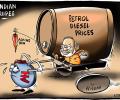
Price of international crude oil - the raw material for making petrol and diesel - dropped to a three-year low before marginally recovering but a revision in domestic petrol and diesel rates is likely only if lower rates are sustained, industry sources and officials said. Global oil benchmark Brent crude futures fell below $70 per barrel on Tuesday - the first time since December 2021 - but gained thereafter after Hurricane Francine hit crude supply in the Gulf of Mexico. Brent rose above $71 a barrel on Thursday while West Texas Intermediate advanced to trade near $68.

US strikes on Iran's three main nuclear facilities have once again raised concerns that Tehran might shut down the Strait of Hormuz - one of the world's most critical chokepoints, through which a fifth of global oil and gas supply flows.

However, copious oil supplies amid growing global output and slowing Chinese oil consumption will put India in a better bargaining position with Gulf suppliers.

Among the new entries, the largest by market capitalisation are LIC, Avenue Supermarts (DMart), Adani Green Energy, Zomato and Jio Financial Services.
The wide-ranging sanctions imposed by the US on the Russian oil sector have started to dent near-term oil flows to India with state-owned Bharat Petroleum Corporation Ltd (BPCL) saying not enough cargoes are available for March.
Indian imports of Russian crude oil may stabilise or even decline in 2024 from record 2023 levels amid shrinking discounts, lower output, and a rebound in West Asian supplies, according to the ship-tracking data and industry executives. This may impact the billions of dollars in annual savings that India made last year. Imports of Russian oil jumped by a record 140 per cent in calendar 2023 to 1.79 million barrels a day (b/d) from 740,400 b/d in 2022, when Russia marched into Ukraine in February, and from just 102,000 b/d in 2021, according to the data from Paris-based market intelligence agency Kpler.

This is the case even though the benchmark index is only 5 per cent below its all-time high. The list of stocks trading at a discount primarily consists companies in the automotive, banking, oil and gas, insurance, healthcare, and metal sectors.

India may have to lean more on West Asian nations for supplies of liquefied petroleum gas (LPG), a cooking fuel, in the coming years after Indian state-run refiners drew up big plans to diversify into producing more profitable petrochemicals. This shift leads to reduced LPG output, Indian refining executives said. The mantra for state-run oil companies, from Indian Oil Corporation (IndianOil) to liquefied natural gas (LNG) importer Petronet LNG, which are looking to diversify their businesses from lower-margin fuels, has been value-added petrochemicals.

Brokerages expect a further slowdown in Indian firms' revenue and earnings growth in Q4FY25, following low single-digit growth in the preceding three quarters, as factors like weak consumer demand and credit growth linger on.

The operation went on for 66 hours after a giant 120 feet x 120 feet hoarding collapsed on a petrol pump in the Chheda Nagar area during gusty winds on Monday evening, the official said.

Indian Oil Corporation (IOC) on Tuesday reported halving of its March quarter net profit largely because of losses in the petrochemical business and shrinking margin after it announced a pre-election fuel price cut despite rising input costs. The net profit of Rs 4,837.69 crore in January-March compared to Rs 10,058.69 crore a year back and Rs 8,063.39 crore in the preceding October-December quarter, according to a stock exchange filing by the company.

Truck drivers protesting against a provision in the new penal law on hit-and-run road accidents, called off their strike in Nashik district of Maharashtra on Tuesday after the local authorities assured to look into their demands.

The Trump trade shock is a chance to push long-overdue reforms, rather than tinker with tariffs to appease the US, suggests M Govinda Rao.
Indian imports of Russian oil plunged by a record in August month-on-month (M-o-M) as discounts on the fuel shrank in tandem with rising Brent oil prices. Higher crude prices will drive inflation or hurt earnings at oil companies and India's fiscal position if such spikes are not passed on to consumers. Indian purchases of Russian crude declined by around 24 per cent in August from July to the lowest level since January, with refiners expecting volumes to drop further amid rising rates of Russian benchmark Urals grade, substantial stocks at refiners, and planned maintenance at Indian refineries, according to ship tracking data and industry officials.

The market responded positively to the Q1 results of oil marketing companies (OMCs), Bharat Petroleum Corporation (BPCL) and Hindustan Petroleum Corporation (HPCL) despite numbers being weaker than consensus. BPCL's reported gross refining margin (GRM) was in line at $7.9 per barrel (bbl) in Q1FY25, which implies marketing margin stood at Rs 4.8 per litre. Standalone profit after tax or PAT at Rs 3,000 crore was down versus consensus due to under-recoveries in LPG business.

Billionaire Mukesh Ambani's Reliance Industries has maintained its highest ranking among Indian corporates in the latest Fortune Global 500 list, jumping 16 places to rank at number 88. Reliance was ranked at number 104 in the 2022 ranking and in the 2023 ranking it is placed at number 88, according to the publication. The company has gained a whopping 67 places in the last two years from number 155 in 2021.

Even as Russia and West Asia have been slugging it out for market share in India to sell their crude oil, the US is quietly making its moves on the sidelines. The US has doubled its share of the Indian crude market in the past few months, according to industry sources and ship-tracking data. Some of the increase in America's market share may have come at the expense of Russia, India's biggest crude oil supplier, said industry sources.

BPCL to introduce single-screen theatres at Ghar outlets.
